
Monday 26th October 2026
Monday 26th October 2026
How ordinary societies came to believe that their neighbors were agents of evil and what that reveals about the human mind.
Witch Hunts and the Psychology of Persecution: A Psychosocial History of Humanity’s Fear

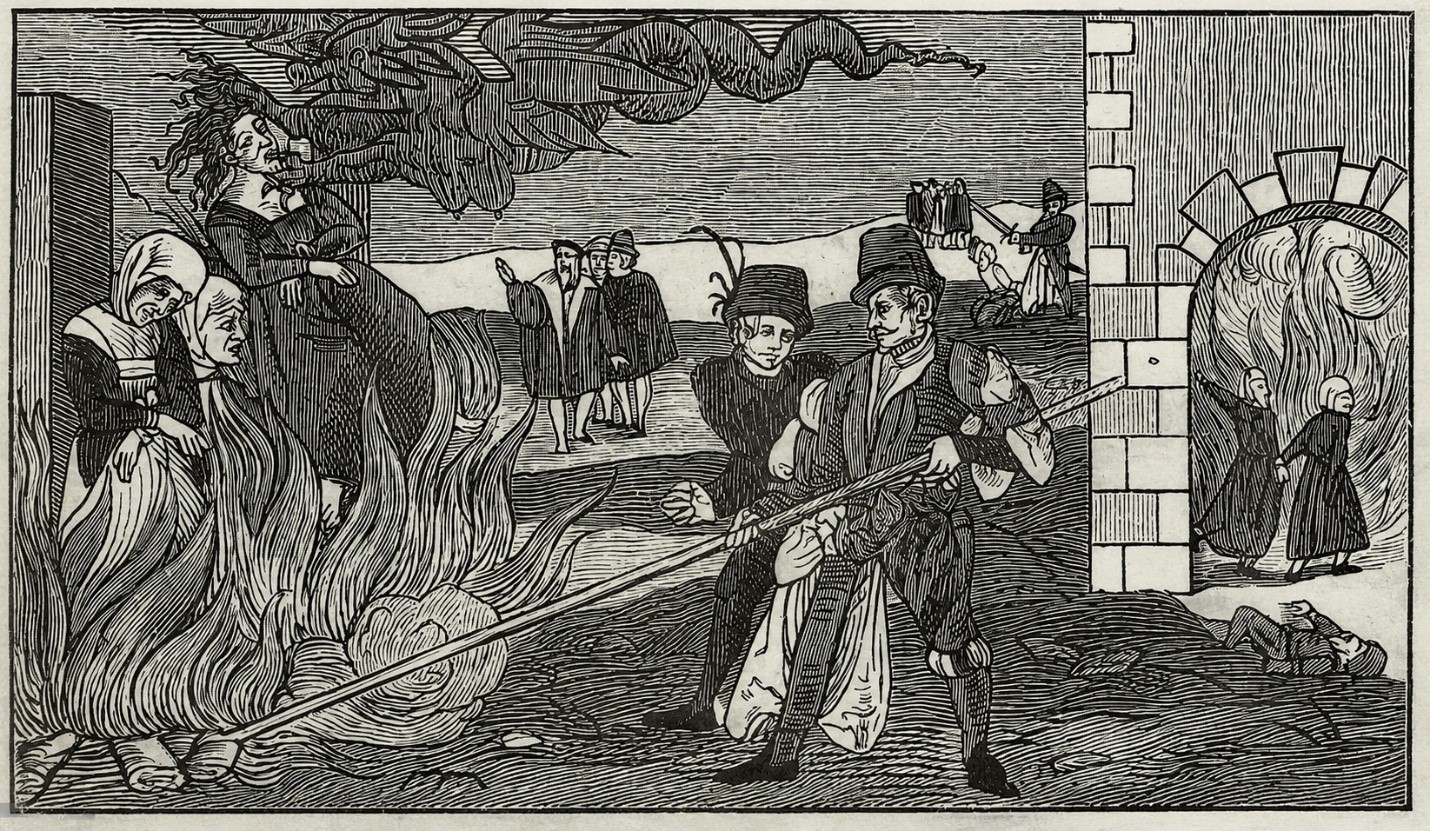
Witch Hunts and the Psychology of Persecution: A Psychosocial History of Humanity’s Fear
Witch hunts were never just about magic; they were about fear. They exposed one of humanity’s darkest psychological truths: the executioners were ordinary people who believed they were doing the right thing.
Driven by panic, religious fanaticism, political agendas, and deep-rooted cognitive biases, entire communities turned against their own neighbors. Tens of thousands of innocent people (most of them women) were tortured, ostracized, and executed, not because of evidence, but because society needed someone to blame.
Understanding witch hunts is not only about remembering the past. It is about recognizing the psychological mechanisms that continue to shape modern forms of persecution.
What Were Witch Hunts?
A witch hunt refers to the organized identification, accusation, prosecution, and often execution of individuals believed to possess supernatural powers or to have entered a pact with evil forces.
During the European witch hunts (c. 1450–1750), especially between 1560 and 1650, almost anything could make someone a suspected witch. A birthmark, owning a black cat, working as a healer or midwife, living alone, speaking your mind, showing signs of mental illness, or even being blamed for a neighbor’s bad harvest or sick child could be enough.
Historians estimate that:
- Between 80,000 and 100,000 people were formally prosecuted for witchcraft.
- Approximately 40,000–60,000 people were executed.
- Around 75–85% of the accused were women, although the proportion varied by region.
These figures are based on extensive archival research by historians such as Brian P. Levack (2016) and Wolfgang Behringer (2004).
Why Did Societies Created Witches?
Societies did not simply discover witches; they created the idea of witches to make sense of fear, uncertainty, and misfortune. Psychologists and anthropologists argue that when people face unexplained events such as disease, crop failure, or death, they seek clear causes rather than accepting randomness.
Arie Kruglanski argues that uncertainty increases the need for cognitive closure, making simple explanations especially appealing. Cognitive scientists Justin L. Barrett and Stewart Guthrie suggest that humans are naturally inclined toward pattern detection and agency attribution, leading them to perceive intentional causes behind unexplained events. Under social stress, communities also engaged in scapegoating, blaming vulnerable individuals particularly women such as widows, elderly women, healers, and the poor, who were already marginalized by patriarchal social norms a process consistent with Henri Tajfel’s Social Identity Theory. As accusations spread, they developed into a moral panic, a concept introduced by Stanley Cohen, in which rumors, forced confessions, and public fear reinforced one another. Once someone was suspected, confirmation bias, demonstrated by Peter Wason, led people to interpret every coincidence or denial as evidence of guilt while ignoring contradictory information. The persistence of witch hunts was further strengthened by obedience to authority, illustrated by Stanley Milgram, and conformity, demonstrated by Solomon Asch, as individuals followed judges, clergy, and the majority even when accusations lacked evidence.
Together, these well-established psychological mechanisms explain why belief in witches became widespread and endured for centuries.
Lesson for Modern Society
Although formal witch trials had largely disappeared by the 18th century, the psychological forces that sustained them have not vanished. They continue to appear in new forms, including conspiracy theories, online harassment campaigns, political scapegoating, moral panics, misinformation, and the persecution of minority groups.
The targets have changed, but the underlying psychology remains strikingly familiar.
Fear and uncertainty still encourage people to accept simple explanations for complex problems. Social media can spread rumors and accusations with a speed and reach that village gossip never could. When communities feel threatened, divided, or powerless, they may still search for an individual or group to blame.
The history of witch trials therefore offers more than a lesson about the past. It reminds modern society to question unverified claims, resist collective fear, and protect those who are most vulnerable to suspicion, exclusion, and persecution.
The tragedy of the witch hunts lies not only in the innocent lives lost, but also in what these persecutions reveal about human behavior. They demonstrate how easily fear can overpower compassion, suspicion can replace evidence, and collective certainty can silence doubt and dissent. The greatest danger was never supernatural power; it was the human capacity to turn uncertainty into conviction and neighbors into enemies.
The legacy of the witch hunts therefore reaches far beyond the historical period in which they occurred. It challenges each generation to confront its prejudices, question collective fears, and defend the principles of evidence, due process, fairness, and human dignity.
We honor those who suffered not simply by remembering them as victims of the past, but by recognizing and resisting the same psychological and social vulnerabilities whenever they reappear in the present.
Reference
- Asch, S. E. (1956). Studies of independence and conformity: A minority of one against a unanimous majority. Psychological Monographs, 70(9).
- Bandura, A. (1999). Moral disengagement in the perpetration of inhumanity. Personality and Social Psychology Review, 3(3), 193–209.
- Behringer, W. (2004). Witches and Witch-Hunts: A Global History. Polity Press.
- Cohen, S. (1972/2011). Folk Devils and Moral Panics. Routledge.
- Levack, B. P. (2016). The Witch-Hunt in Early Modern Europe (4th ed.). Routledge.
- Milgram, S. (1974). Obedience to Authority. Harper & Row.
- Gustav Henningsen (Ed.). (1980). Early Modern European Witchcraft: Centre’s and Peripheries. Oxford University Press.
- Robin Dunbar (1998). The Social Brain Hypothesis. Evolutionary Anthropology, 6(5), 178–190
Related Post

Recent
Popular
- Internet Addiction and Forgetfulness: Is There Really a Connection? 25 August 2026
- Why Can You Remember a Face But Not a Name? 17 August 2026
- From Spirit Possession to Schizophrenia: How Myths About Mental Illness Continue to Harm Lives 30 June 2026
- Witch Hunts and the Psychology of Persecution: A Psychosocial History of Humanity’s Fear 29 June 2026
- Breaking the Stigma: Common Misconceptions About Mental Disorders 27 June 2026

Recent Posts
- Internet Addiction and Forgetfulness: Is There Really a Connection?
- Why Can You Remember a Face But Not a Name?
- From Spirit Possession to Schizophrenia: How Myths About Mental Illness Continue to Harm Lives
- Witch Hunts and the Psychology of Persecution: A Psychosocial History of Humanity’s Fear
- Breaking the Stigma: Common Misconceptions About Mental Disorders
Recent Comments
No comments to show.
Editor: JUM Nazmul Hossain
Director and Consultant Psychologist Center for Psychological Health, UK Institute of Psychology and Health
Joint-Editor: Sayada Zakia Sultana
Co-Director and Consultant Psychologist Center for Psychological Health, UK Institute of Psychology and Health
Contact Us
Email: iphtrustbd@gmail.com
Phone: +447828196120
For appointments, collaborations, or general inquiries, please contact us.
Developed by: Ifad Technology
Developed by: Ifad Technology